Copper Vitality
A creative system for a brand stuck at $100 a day, and the cheapest purchases in the account
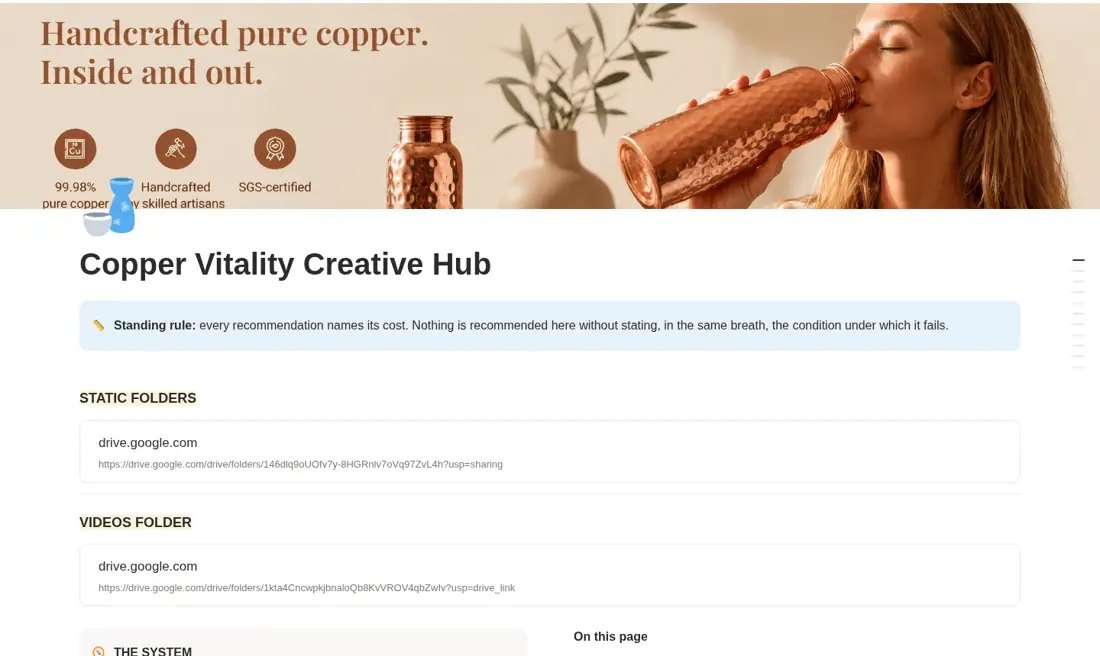
A Netherlands-run DTC brand selling hand-hammered copper water bottles in 6 markets. Below about $100 a day a campaign held 3 to 3.5 ROAS; above it, performance broke and nobody knew why. We joined as the creative strategist and built the system: research, avatars, mechanisms, angles, hooks, scripts and every brief the editors built from. Media buying stayed with the founders.
- 1Audit4 exports read, 7 beliefs tested, most of them wrong.
- 2Research14 documents, a numbers register, break-even per market.
- 3SystemThe hub: avatar to mechanism to angle to brief to hooks.
- 4Briefs84 in 8 weeks, 231 variations, every one with a hypothesis.
The first 2 weeks were an audit, and most of what everyone believed was wrong. The account spent $4,046 a month, not $10,000. Two angles had taken 72% of all spend ever. Video "did not work", on 34 three-second plays in the account's whole history. The UK was called a core market while New Zealand bought a purchase for $13.84 against the UK's $26.78. Three attribution windows were live at once, so no ROAS could be compared with another. 125 ad sets, 91 of them inactive and never cleaned up. And a "94% of copper bottles are plated" statistic had run in live ads for 47 days.
HYLN's part, Santi on the account: creative strategy end to end from 1 August 2026. Media buying and scaling decisions stayed with the founders. Figures are from the account's Ads Manager exports, 19 August to 17 September for campaigns and 25 August to 23 September for ads, on Meta's default attribution.
Research before the first brief, a system every ad traces through, and every recommendation naming its cost.
14 research documents before a single brief, about a million characters: market voice from Amazon, Reddit, TikTok, Instagram and bol.com reviews per country, 61 sourced evidence rows; what the brand's lab report proves and the 5 mechanisms it cannot claim yet; 3 competitors torn down page by page (they give a shopper 9 ways to buy, the brand gave 2); break-even by market, from 1.42x in the UK to 1.80x in the Netherlands; and a numbers register where every figure used anywhere lives with its source.
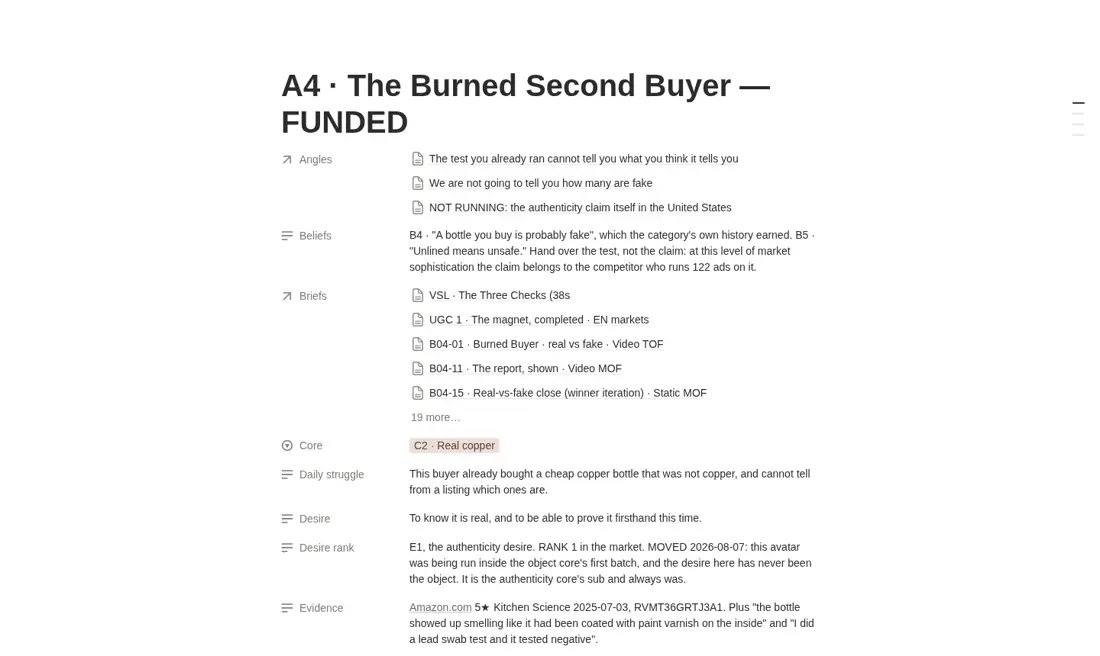
The creative hub the whole team runs on, in Notion. The chain every ad follows: research, core avatar, sub-avatar, mechanism, angle, concept, brief, hooks A, B and C. 22 avatars consolidated to 3 funded ones. 37 angles, 12 of them recorded as off the table and why. 14 mechanisms, each marked provable now, proof needed or cannot claim. 33 hypotheses written before launch. 143 reusable blocks. A weekly rhythm, a brief format, a media buyer runbook and one naming convention that ties an Ads Manager row back to the brief that caused it.
84 briefs in 8 weeks, 231 variations: 44 statics, 32 videos, 5 UGC, 3 carousels, across 6 markets. Every brief ships with 3 hooks over one shared body. Iterations of the account's own winners, imitations of proven competitor structures, and net-new tests, in that order of weight.
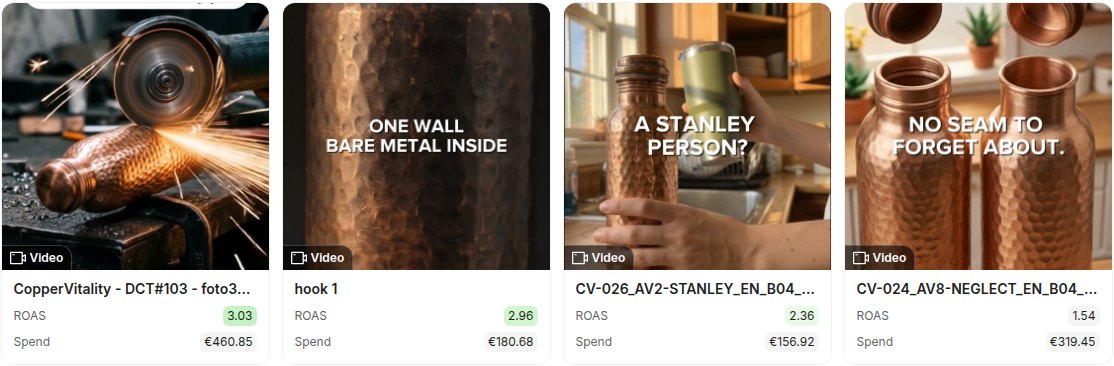
The breakthrough: the Burned Second Buyer, an avatar built from one Amazon review ("had to return it because it was not 100% copper despite the ad saying it was"). Its campaign bought purchases at €20.71, cheaper than any other campaign in the account, the founders' mature winners included. And video finally worked: the top static rebuilt as a video with 3 hooks spent €399 at 2.88 ROAS.
Compliance, written inside what the brand can prove: a ledger of 74 claims, each with evidence, a do-not-say line and approved wording, 60 cleared and 14 blocked. The 94% statistic was traced to a fake persona page run by the biggest competitor and replaced with 3 checks a buyer runs herself.
Past the ad: strong hooks and weak sales sent us to the checkout. 26,840 link clicks, 23,344 landing page views, 2,756 add-to-carts, 609 purchases; a checkout event firing fewer times than purchases; no guarantee visible, no discount anchor, the wrong currency in some markets. A conversion audit, a 3-market landing page rebuild and pre-landers for the winner followed.
What did not work, stated plainly: across all ads from our briefs in the 30 days to 23 September, €3,258 spend, 87 purchases, 1.83 ROAS, against 2.74 on the founders' own ads. Ours win on click-through, 2.66% against 1.81%, and lose on conversion, and they carry more video, at 2 to 3 times the CPM. The account's growth from about $135 a day to about €548 is the founders' scaling of their own winners; our job was to give it more to scale with.

The audit was worth more than the first month of briefs. Most of what the account believed about itself was wrong, and every brief written on those beliefs would have been wrong with it. Read the exports first, write down what they can and cannot tell you, and let one honest review build the avatar that wins.